





Introduction
In a city as diverse as Hong Kong, bilingual education is no longer optional—it’s a necessity for growth and development. As a result, ever since the late 1990s and early 2000s, preschools in Hong Kong have slowly adopted the idea of bilingual education. Nowadays, you’ll find a wide range of different learning philosophies and approaches, each with its own benefits and considerations. Children growing up in a bilingual environment not only become proficient Chinese and English speakers, they also experience the many benefits of being a true bilingual learner.
Types of Bilingual Learning
In general, Hong Kong preschools implement one of three approaches, from fragmented languages classes to fully-immersive programs. Understanding their differences helps you choose the best fit for your child’s needs.
Language Classes
Language classes are perhaps the most common in Hong Kong preschools. The majority of subjects are taught in one language (i.e. Chinese or English), and the second language is taught as a separate language class.
Features
Fixed weekly sessions focusing on teaching the second language, usually with a focus on grammar and vocabulary.
Best for
Families who prefer more targeted learning experiences that allow their children to focus on specific concepts and rules of the language.
Advantages
Establishes a knowledge framework for the second language with minimal time commitment.
Limitations
Lacks cultural context and real-life application. For example, children may be able to memorize and recite words but have difficulty actually speaking their second language with others.
Examples in Hong Kong
Hong Kong YMCA language courses; Kowloon City Baptist Kindergarten
Traditional Bilingual Programs
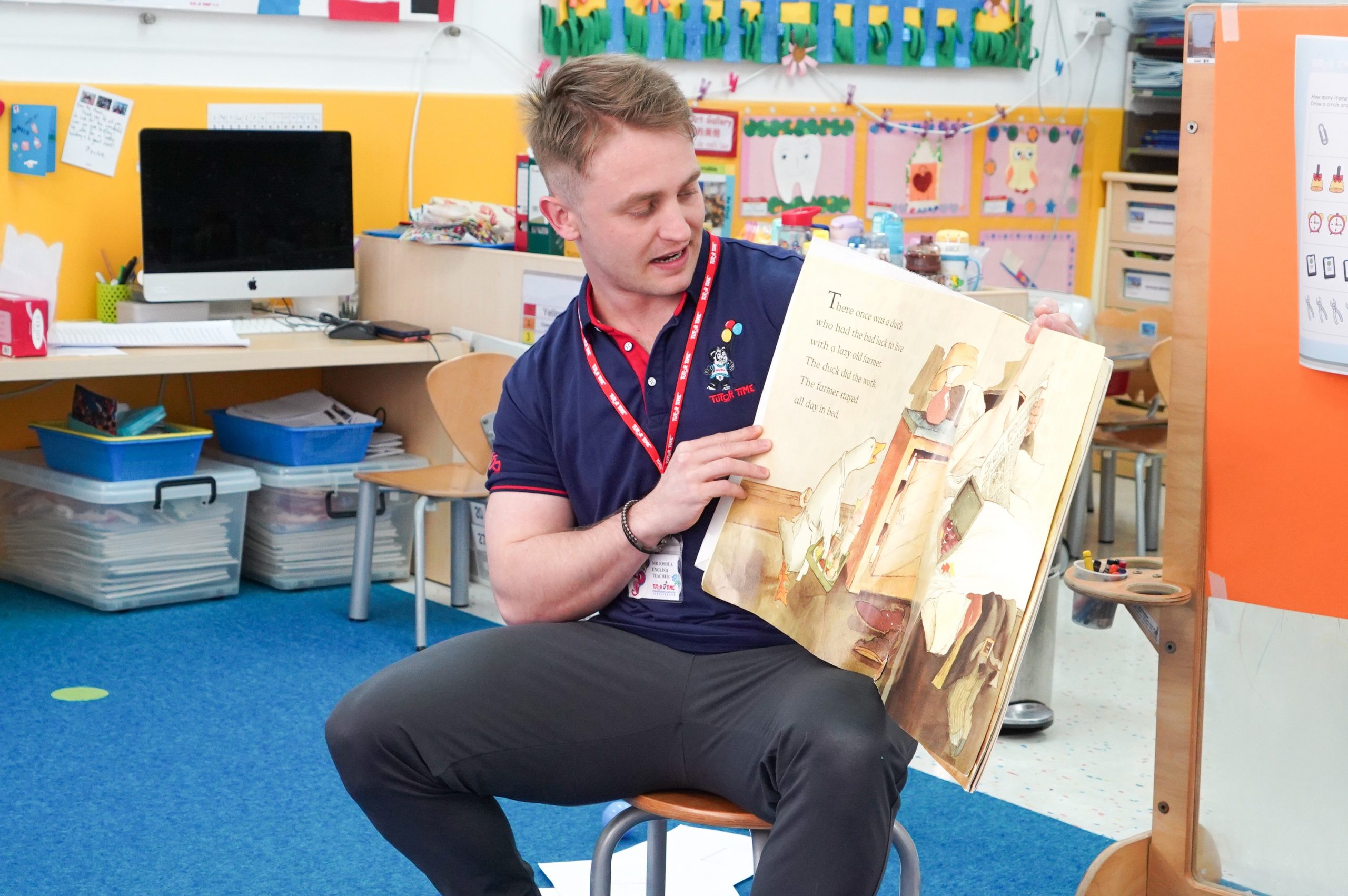
In bilingual programs, teachers may use different languages depending on the context of the lesson. For example, they might use English for storytelling, and then switch to Cantonese for discussing questions related to the story.
Features
Some subjects or parts of the lesson are taught in a second language.
Best for
Families seeking a balance between academic learning and language development, as well as a more flexible approach compared to isolated language classes.
Advantages
Allows students to learn their second language in different contexts rather than just a language class. This makes their language learning experience more functional and adaptable.
Limitations
Relative to full-immersion programs, the exposure to the second language is still considerably less. Children often switch back to their preferred language (in Hong Kong, this is usually Cantonese) after briefly using the second language.
Examples in Hong Kong
St. Catherine’s International School; Springfield International School
Full-Immersion Bilingual Programs
In full-immersion programs, children are exposed to both languages equally. During English immersion time, native English teachers will only use English for all activities and communication (and vice versa for Mandarin/Cantonese).
Features
50/50 exposure to both languages, facilitated by native language teachers. Children are encouraged to only use the language that is being taught in that session.
Best for
Families who want their children to learn both languages in a holistic way, encouraging usage of both languages in many different contexts.
Advantages
Full-immersion allows for better native pronunciation and fluency since children can mimic native speakers in different contexts (i.e. pretend grocery shopping, storytelling etc). It also has better cultural integration and allows for a deeper understanding of each language.
Limitations
Full-immersion programs may be overwhelming for children who are a little more shy or less confident in using their second language. But great teachers are usually able to help them feel better in class.
Examples in Hong Kong
Tutor Time’s fully-immersive English and Mandarin program
A quick overview of the different types of bilingual learning
| Criteria | Language Classes | Traditional bilingual programs | Full-immersion bilingual programs |
| Second language exposure | 2 to 3 hours per week | 30 to 50% of class time | Full-day immersion |
| Cultural integration | Cultural knowledge from textbooks | Theme-based cultural experiences | Real-world application |
| Second language activation | Activated only during language class | Activated during certain parts of the lesson | Continuously activated across all subjects |
The Long-term Benefits of Bilingual Learning
Better Language Abilities
Bilingual children develop stronger reading and writing skills, not just in both languages, but overall. They have a better understanding of different language frameworks and rules, which allows them to discern nuances, expand their vocabulary, and improve their verbal and written communication.
Improved Social-Emotional Skills
Bilingual children are better able to show empathy and understand different perspectives and cultures. A study from the University of Chicago found that bilingual children inherently try to understand other people’s perspectives, and do so even better than monolingual adults. Over time, they also develop better cross-cultural communication and develop more diverse relationships.
Better Concentration and Regulation
According to research, bilingual children demonstrate better ability to concentrate, regulate their thoughts, and multi-task more effectively. This is also confirmed by brain scans that show physical differences in bilingual children’s brain structure. In the long-run, bilingual individuals show sharper cognitive function, better memory, and delayed cognitive decline.
Academic Success
Because bilingual children tend to have excellent executive functioning, this allows them to solve complex problems, think critically, and enhance their creative thinking skills. All of these skills contribute to their overall academic success.
Debunking Common Bilingual Learning Myths
Does bilingualism cause language delays?
Short answer – no. Research shows that bilingual children reach language milestones (first words, phrase formation, grammatical complexity) at the same pace as monolingual children.
Does bilingualism lead to language confusion?
The answer is also no. In fact, code-switching (the switching of languages mid-sentence) is natural and beneficial. It reflects advanced cognitive control, not confusion. As vocabulary grows in both languages, code-switching usually decreases.
Conclusion
In Hong Kong’s diverse landscape, bilingual education is not only useful for learning, it helps bridge cultural and communication gaps, and has benefits outside of just language development. Choosing the right type of bilingual education is equally important, which is something that parents should consider when choosing the right preschool program for their children. Ultimately, bilingual learning is a step towards raising confident, adaptable, global citizens.
Explore more: Tutor Time’s full-immersion bilingual English and Mandarin programs
References
- https://www.greek123.com/blog/how-bilingualism-boosts-academic-performance/#:~:text=In%20addition%20to%20improved%20reading%20skills%2C%20bilingual,effectively%20in%20both%20spoken%20and%20written%20forms.
- https://www.legco.gov.hk/research-publications/cn/essentials-1415ise21-language-policy-in-singapore.htm
- Poulin-Dubois, D., Blaye, A., Coutya, J., & Bialystok, E. (2011). The effects of bilingualism on toddlers’ executive functioning. Journal of experimental child psychology, 108(3), 567-579.
- Marzecová, A., Bukowski, M., Correa, Á., Boros, M., Lupiáñez, J., & Wodniecka, Z. (2013). Tracing the bilingual advantage in cognitive control: The role of flexibility in temporal preparation and category switching. Journal of Cognitive Psychology, 25(5), 586–604. https://doi.org/10.1080/20445911.2013.809348
- Paradis, J., Genesee, F., & Crago, M. B. (2010). Dual language development and disorders. Brookes Publishing Company.


 Mon-Sat